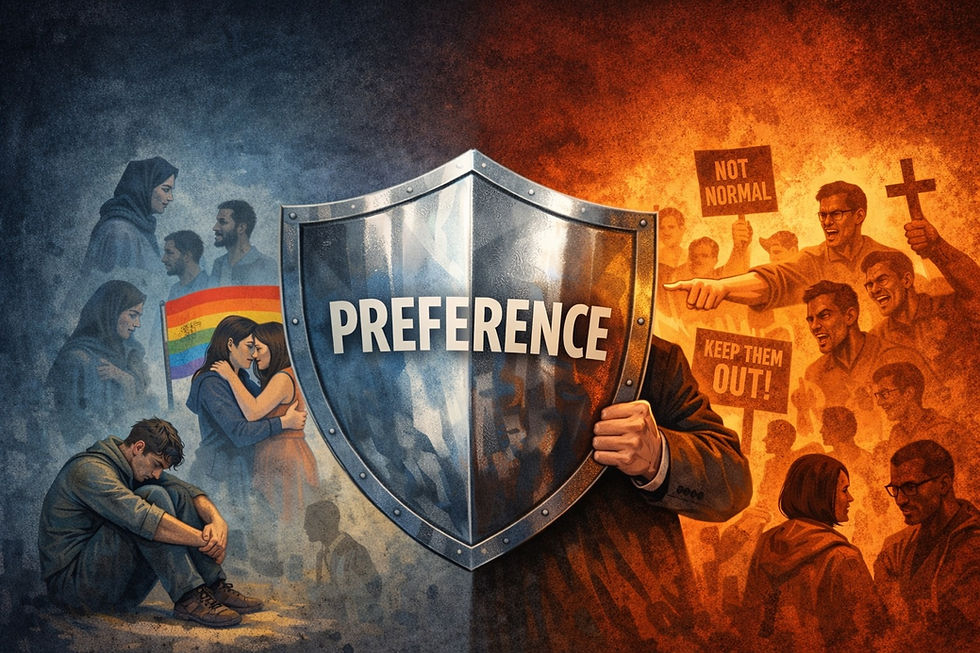
Why Inclusion Feels Like a Threat
- Triston Grant

- Jan 16
- 3 min read

Inclusion is often framed as a moral demand. A request for agreement, endorsement, or ideological alignment. This framing makes inclusion easy to reject. People respond by insisting they cannot support something that conflicts with their values, beliefs, or worldview. The disagreement is cast as philosophical, ethical, or religious.
But this framing misunderstands what inclusion actually does.
Inclusion does not demand approval. It does not require agreement. It does not ask anyone to change their private beliefs. What it threatens is not values, but hierarchy. And that distinction matters.
Hierarchy is the invisible structure that determines whose existence feels normal, whose voice feels authoritative, and whose presence requires justification. It ranks lives implicitly, often without ever naming itself. Inclusion disrupts this ranking by insisting that legitimacy is not conditional.
This is why inclusion feels destabilizing even to people who describe themselves as tolerant.
Most social hierarchies rely on conditional belonging. Some identities are treated as default. Others are treated as deviations that must explain themselves. Inclusion collapses this distinction. It removes the requirement that certain people earn recognition through conformity, respectability, or silence.
That removal is deeply unsettling to systems built on stratification.
When people resist inclusion, they often say they are protecting tradition, morality, or social order. But these explanations rarely withstand scrutiny. Traditions change constantly. Moral standards evolve. Social order adapts when it benefits those at the top. What remains consistent is resistance to the redistribution of standing.
Inclusion does not erase difference. It erases ranking.
This is why inclusion is frequently reframed as excess. As going “too far.” As demanding special treatment. These accusations reveal the underlying anxiety. Equality feels excessive only in a system calibrated around inequality. When hierarchy is normalized, equal treatment appears disruptive.
A useful way to see this is to ask a simple question: what exactly is being lost through inclusion?
Rarely is the answer safety, coherence, or ethical clarity. More often, what is lost is unchallenged authority. The ability to decide whose existence feels legitimate and whose feels questionable. Inclusion removes that power from informal gatekeepers and redistributes it broadly.
This is not a moral loss. It is a positional one.
Many people confuse these two because hierarchy often disguises itself as value. Longstanding dominance begins to feel principled simply because it has gone unchallenged for so long. When inclusion threatens that dominance, it is experienced as an attack on meaning rather than a challenge to power.
This confusion is reinforced by language. Inclusion is framed as endorsement. Recognition is framed as agreement. But recognition does not require affirmation. A society does not collapse because it acknowledges the legitimacy of lives it does not personally understand.
Pluralism depends on this distinction. It is the difference between coexistence and conformity.
A society that conditions dignity on approval is not pluralistic. It is hierarchical. It allows difference only insofar as difference remains marginal, quiet, or deferential. Inclusion refuses this arrangement. It insists that legitimacy is not something granted by those already centered.
This insistence exposes the fragility of hierarchy.
Hierarchies survive by appearing natural. They present themselves as the way things are rather than as systems that benefit specific groups. Inclusion interrupts this illusion by making the structure visible. Once visible, hierarchy must justify itself rather than simply persist.
This is why inclusion often triggers disproportionate backlash. The reaction is not to inclusion itself, but to exposure. When ranking is challenged, those who benefited from it feel destabilized, even if nothing tangible has been taken from them.
Importantly, inclusion does not flatten differences. It does not erase disagreement. It does not require moral consensus. What it does require is a shift from permission to recognition.
Permission implies authority. Recognition implies equality.
That shift is what many people resist, even when they struggle to articulate why. It is easier to say “this conflicts with my values” than to say “this diminishes my relative standing.” But the latter is closer to the truth.
Social progress often stalls not because values are threatened, but because hierarchies are.
Inclusion is unsettling because it asks societies to operate without informal rankings of worth. It asks people to live alongside difference without adjudicating its legitimacy. For systems built on conditional belonging, this feels like loss.
But it is not loss. It is recalibration.
Inclusion does not take meaning away from anyone. It takes authority away from structures that were never morally entitled to it in the first place.
Recognition is not endorsement. It is the minimum requirement for justice.